 Jerusalem Israel Tours
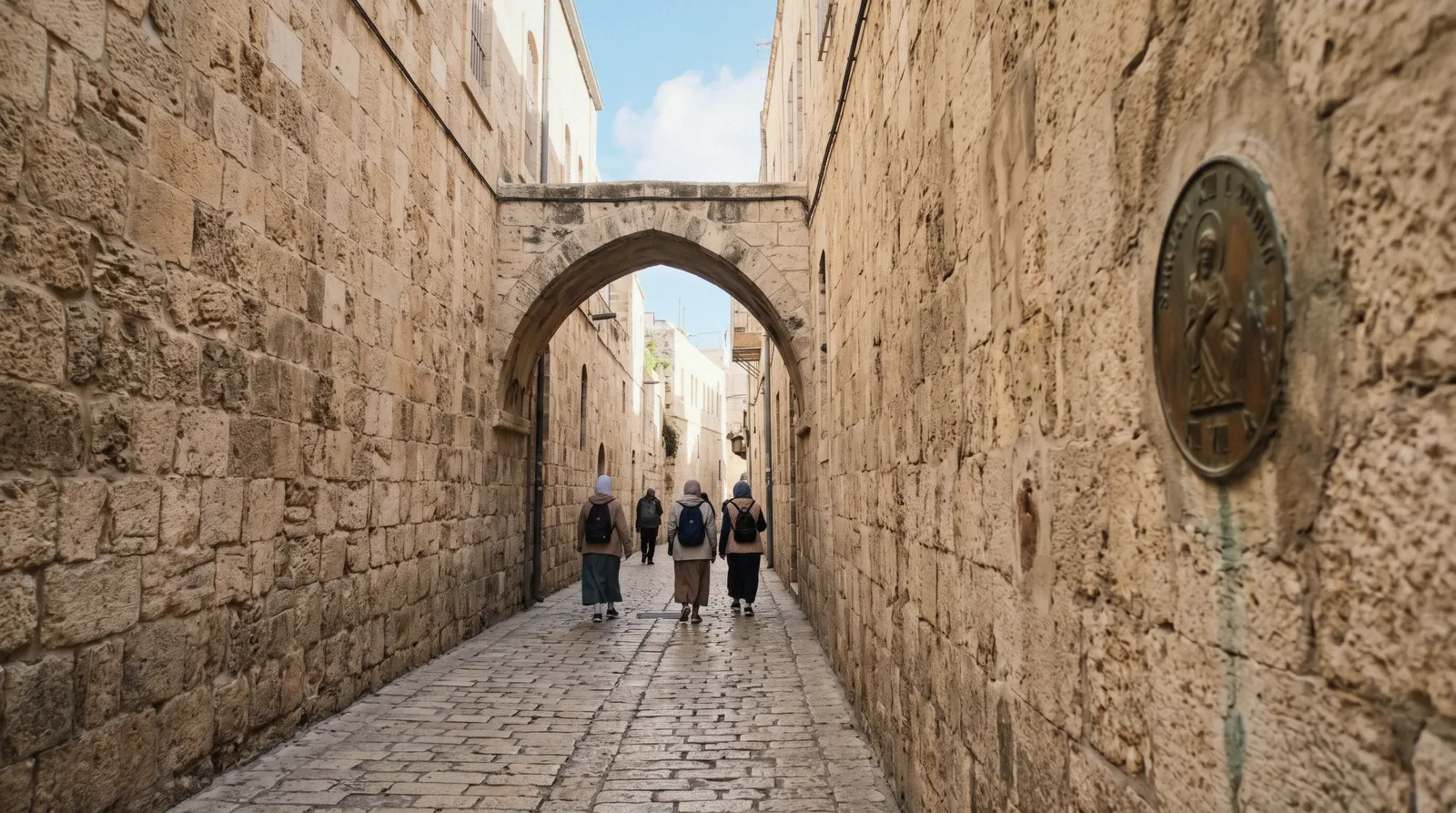
The Via Dolorosa is the processional route across the Old City of Jerusalem that marks the path Jesus is believed to have walked to his crucifixion. It runs about 600 metres from the former Antonia Fortress to the Church of the Holy Sepulchre, marked by 14 Stations of the Cross. This guide covers the stations in walking order, the timings that matter, and which guided tour makes the walk easier. For the full shortlist, see the top Jerusalem tours.
Quick answer The Via Dolorosa in one minute
The Via Dolorosa, Latin for the Sorrowful Way, is the route through the Old City of Jerusalem that marks where Jesus is believed to have carried the cross to his crucifixion. It runs about 600 metres and is marked by 14 Stations of the Cross, nine in the street and five inside the Church of the Holy Sepulchre. Walking it slowly with the churches takes one to two hours, our estimate, and the route is free.
Key takeaways
- The walk is free and open at all hours, so the only decision is on your own or with a guide.
- The four-hour Old City walking tour covers the Via Dolorosa, the Western Wall and the Holy Sepulchre for $57 per person.
- Pair the route with the Church of the Holy Sepulchre, where the last five stations are inside.
Key facts
Opening hours
| Street route | Open at all times–Open at all times |
|---|---|
| Church of the Flagellation | 07:00–18:00 summer, 17:00 winter |
Closed None for the street itself. Saint Anne and the Pools of Bethesda close on Sundays.
Admission
- Adult
- Free street route
- Reduced
- Saint Anne students $3.24 (10 NIS)
- Free
- The whole route is free to walk
Planning it
- Time needed
- Our estimate: 1 to 2 hours for a slow walk with the churches, 30 to 45 minutes for the street alone
- Book ahead
- Optional — walk-up usually fine
- Address
- Via Dolorosa, Muslim Quarter and Christian Quarter, Old City of Jerusalem
Via Dolorosa: the tours compared
The tours that cover this place, side by side: listed price, length and what the ticket buys, read from the GetYourGuide and Viator listings.
Do you want a short walk on foot, or a longer day with transport?
| Option | Price | Length | Includes | Book |
|---|---|---|---|---|
| Old City guided walking tourTop rated | from $57 | 4 hours | No entry fees on the route | Check Availability |
| Old City walking tourSame route on Viator | from $58 | 4 hours | No entry fees on the route | Check Availability |
| In the footsteps of Jesus walking tourChristian sites | from $89 | 9 hours | Entry to Pater Noster and Dominus Flevit not included | Check Availability |
Prices are the platforms' own listings. Figures current in Q4 2026.
How to see it: on your own or with a tour
The Via Dolorosa is a free public street, so entry is never the issue. The real choice is between finding the 14 stations yourself, with their small wall plaques easily missed in the souk, and walking them with a guide who keeps the order and explains each one. Here is how the options compare.
| Option | Cost | Time | Best for | Watch out for |
|---|---|---|---|---|
| Self-guided walk, street only | Free | 30 to 45 min (our estimate) | Early risers and return visitors | The station plaques are small and the route turns through the market lanes |
| Self-guided plus the two churches | $16.50 (51 NIS) if you add Saint Anne and the Austrian Hospice rooftop | 1 to 2 h (our estimate) | Travellers who want the Pools of Bethesda as well | Saint Anne closes on Sundays and at midday |
| The four-hour Old City walking tour | From $57 per person | 4 h | First-time visitors who also want the Western Wall and Holy Sepulchre | Temple Mount viewpoint replaces the plateau visit on Fridays, Saturdays and some holidays |
| The Old City small-group walk | From $58 per person | 4 h | Visitors who want the souk and Temple Mount viewpoint added | Same Friday and Saturday plateau rule |
| The Footsteps of Jesus full-day tour | From $89 per person | 9 h | Pilgrims who want the Mount of Olives descent before the Via Dolorosa | Entry to the Pater Noster and Dominus Flevit churches is not in the price |
There is no ticket for the route itself.
Guided tours that include the Via Dolorosa
All three of these walks put the Via Dolorosa at the centre of the route. Each can be cancelled free up to 24 hours before the start.
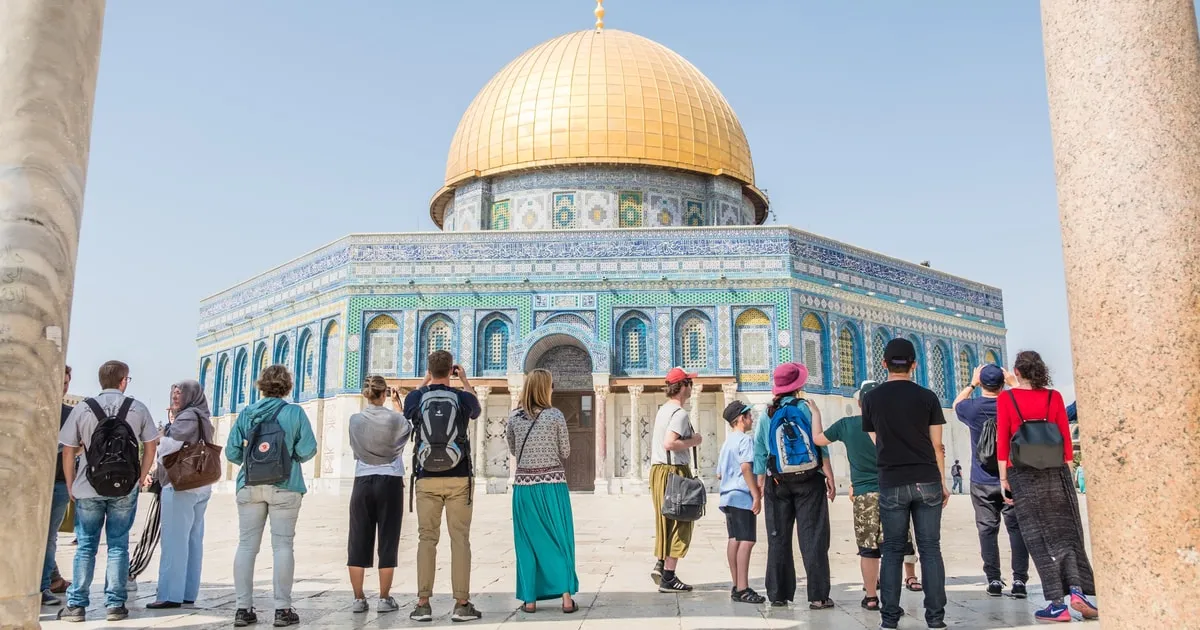 from $57
Top rated
Jerusalem: Guided Walking Tour of the Old City
Four hours on foot from Jaffa Gate: the Western Wall, the Via Dolorosa and the Church of the Holy Sepulchre with a live guide.
Check Availability from $58
Same route on Viator
Old City of Jerusalem Guided Walking Tour
The Holy Sepulchre, the Temple Mount, the Western Wall, the Via Dolorosa and the souk in four hours from Jaffa Gate.
Check Availability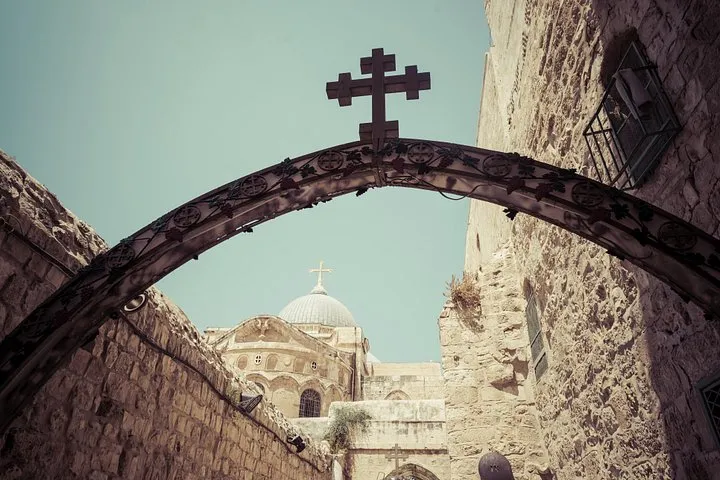 from $89
Christian sites
Jerusalem Walking Tour: In the Footsteps of Jesus
Down the Mount of Olives past Pater Noster, Dominus Flevit and Gethsemane, then the Via Dolorosa in the Old City.
Check AvailabilityPrices, ratings and details are the platform's own. dollar figures are the listed prices — the platform bills in your account's currency.
What the Via Dolorosa is and why it matters
A narrow street in the Old City that has carried Christian pilgrimage for centuries, and the reason many travellers come to Jerusalem at all.
The meaning of the name
Via Dolorosa is Latin for the Sorrowful Way, often translated as the Way of Suffering. In Arabic the street is Tariq al-Alam, and in Hebrew it keeps the Latin name. It is sometimes called the Via Crucis, the Way of the Cross, which is where the English phrase way of the cross Jerusalem pilgrims use comes from.
The name describes what the route commemorates: the path Jesus took, forced by Roman soldiers, on the way to his crucifixion.
What the route actually is
The winding route runs about 600 metres, roughly 2,000 feet, from the site of the former Antonia Fortress near the Lions' Gate to the Church of the Holy Sepulchre in the Christian Quarter. It crosses the Muslim Quarter and passes through one of the busiest market areas of the Old City. Nine of the 14 Stations of the Cross are marked in the streets themselves.
The remaining five are inside the Church of the Holy Sepulchre.
Why the route matters to pilgrims
For Christians this is a celebrated place of pilgrimage, and walking it is an act of devotion rather than simple sightseeing. The current route has been fixed since the 18th century, replacing several earlier versions, so the street you walk is the settled form of a tradition that has shifted over the centuries. The Holy Sepulchre at its end has been the holiest site in Christianity since the fourth century, which is why the walk always finishes there.
The 14 stations in walking order
The stations are numbered along the route, and knowing what each marks turns a confusing market street into a readable sequence.
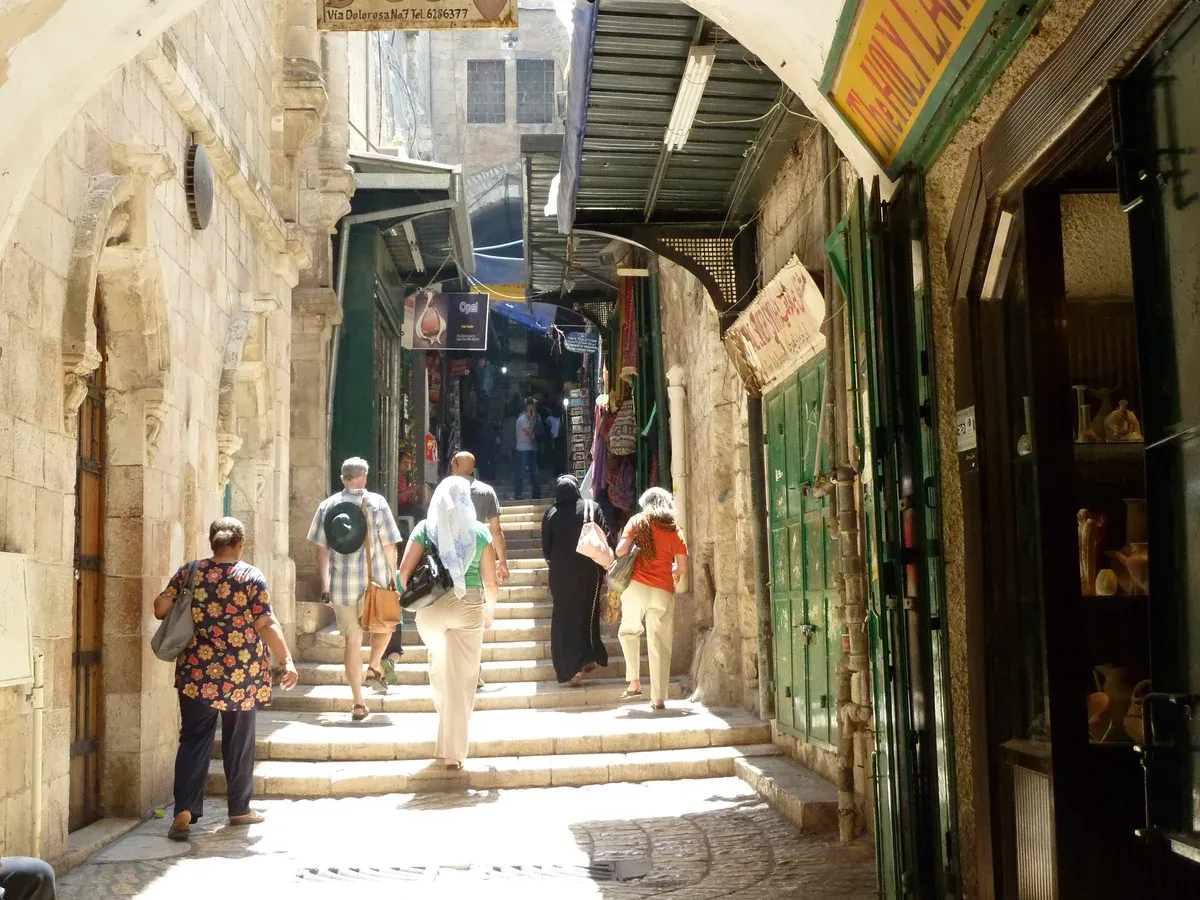
A stepped lane of the Via Dolorosa in the Old City. Photo: Vladislav Bezrukov from Walldorf, Germany, CC BY 2.0, via Wikimedia Commons
Stations 1 to 5: the Muslim Quarter
Station 1 is the Omariyya School, opposite the Monastery of the Flagellation, where Jesus is believed to have been condemned to death. Station 2 marks the Flagellation and the taking up of the cross, at the churches of the Flagellation and the Condemnation. Station 3 recalls the first fall, Station 4 the meeting with his afflicted mother Mary, and Station 5 where Simon of Cyrene is said to have helped carry the cross.
This stretch is signed and comparatively quiet in the morning.
Stations 6 to 9: into the market streets
Station 6 remembers Veronica wiping the face of Jesus. Station 7 marks the second fall, near the point where the route passes under a decorated arch. Station 8 is where Jesus is said to have spoken to the women of Jerusalem.
Station 9, the third fall, sits just outside the Church of the Holy Sepulchre compound. The market is busiest through the middle of the day, so early morning gives you space at the plaques.
Stations 10 to 14: inside the Holy Sepulchre
The last five stations are all inside the Church of the Holy Sepulchre. Station 10 is where Jesus was stripped of his garments, Station 11 where he was nailed to the cross, and Station 12 where he died, all at the rock of Calvary or Golgotha. Station 13 marks the taking down of the body and Station 14 the tomb itself, enclosed by the 19th-century shrine called the Aedicule.
Free entry, with summer hours 05:00 to 20:45.
Hours, dress and quiet times
The street never closes, but the churches along it do, and the Friday procession reshapes the whole afternoon.
Opening hours that matter
The route itself is free and open at all hours. The Church of the Flagellation opens 07:00 to 18:00 in summer and to 17:00 in winter. Saint Anne and the Pools of Bethesda at the start of the route cost $3.88 (12 NIS), students $3.24 (10 NIS), open Monday to Saturday 08:00 to 12:00 and 14:00 to 16:00, closed Sundays.
The Austrian Hospice rooftop viewpoint on the route costs $1.62 (5 NIS), open daily 10:00 to 22:00 with the café on the same hours.
The Friday procession
The Franciscan Way of the Cross walks the route every Friday, starting at the Omariyya School opposite the Monastery of the Flagellation at 16:00 in summer and 15:00 in winter. Joining it is the most traditional way to make the walk, but it means crowds and a slow pace. If you want the street quiet, go any other morning.
The Holy Sepulchre also holds its own daily Franciscan procession at 17:00 in summer and 16:00 in winter.
Dress and behaviour
Modest dress is the safe rule in every church on the route, which means covered shoulders and knees. Inside the Holy Sepulchre and the Flagellation churches, keep voices low and follow the flow of pilgrims. During services and processions, stand to the side rather than across the path.
Fridays in the Old City are also sensitive around the Western Wall and the Temple Mount, so build in extra time if your route crosses the plaza.
Getting there
The route starts near the Lions' Gate in the north-east corner of the Old City and ends in the Christian Quarter.
From central Jerusalem
The fastest approach for most visitors is on foot through Jaffa Gate, then east through the Christian Quarter, about 15 to 20 minutes, our estimate. But this brings you to the end of the route. To walk the stations in order, continue to Damascus Gate and then to the Lions' Gate side, which adds another few minutes.
See our guide to getting around Jerusalem for buses and the light rail, which stops near Damascus Gate.
Starting from the correct end
Station 1 is the Omariyya School near the Lions' Gate, so that is the traditional start. Coming from Damascus Gate, walk straight down El-Wad Road until you reach the school and the Monastery of the Flagellation opposite. If you are joining the Footsteps of Jesus full-day tour, the approach is different: the tour comes down the Mount of Olives and enters through the Lions' Gate area, so the stations fall naturally into place after Gethsemane.
Shabbat and timing notes
The Via Dolorosa is in the Christian and Muslim Quarters, so it is unaffected by Shabbat, and the churches stay open on Saturdays. Public transport outside the walls stops from Friday sunset to Saturday nightfall, so plan to walk. If you are staying in the centre, see our advice on where to stay in Jerusalem, because a hotel within walking distance makes an early-morning start on the route easy.
How much time to give it
The route is only 600 metres, but the churches, queues and crowds decide the clock.
Realistic timings
The street alone takes 30 to 45 minutes, our estimate, if you simply follow the plaques. Adding the Church of the Flagellation and the Holy Sepulchre properly makes it one to two hours. Add Saint Anne and the Pools of Bethesda at the start and the Austrian Hospice rooftop at the end, and a half-day is realistic.
Guided walks take longer again because a guide holds the group at each station.
Three ways to route it
The table below gives three tested shapes for the day, from a quick pass to a full pilgrimage day. All start at the traditional Station 1 and end at the Holy Sepulchre. Times are our estimates.
| Routing | Time needed (our estimate) | What it covers |
|---|---|---|
| Quick pass | 30 to 45 min | All nine street stations, then into the Holy Sepulchre for the last five without lingering |
| Half day with the churches | 2 to 3 h | Saint Anne and the Pools of Bethesda, the Flagellation churches, all 14 stations, the Holy Sepulchre roof and Aedicule |
| Full pilgrimage day | 6 to 8 h | The Mount of Olives descent and Gethsemane first, then the Via Dolorosa and a long visit to the Holy Sepulchre, the shape of the nine-hour Footsteps of Jesus tour |
Building the day around it
Most visitors pair the route with the Holy Sepulchre, which sits at its end, and the Western Wall, about 10 to 15 minutes away, our estimate. If you only have one day in the city, follow our Jerusalem itinerary, which slots the Via Dolorosa into the morning before the crowds build. For a wider shortlist of the city's sights, see our page on things to do in Jerusalem.
How the route came to be
The Via Dolorosa you walk today is the settled form of a tradition shaped over many centuries.
-
1st century AD
The events commemorated
The route commemorates the path Jesus is believed to have taken from condemnation to crucifixion, an event placed by Christian tradition in Jerusalem in the first century.
-
c. 135 AD
A temple covers the site
Emperor Hadrian covered the tomb and built a Temple of Aphrodite over the spot, where it remained until the fourth century.
-
c. 325 AD
Constantine builds the church
Constantine uncovered the tomb and built the church and rotunda at the site, confirmed by scientific testing, making the endpoint of the route a pilgrimage church.
-
1009
Destruction and rebuild
The church was destroyed in 1009 and reconstructed after 1048 under Emperor Constantine IX Monomachos.
-
1099
Crusader changes
After the crusaders captured Jerusalem the church was modified repeatedly, departing significantly from the original structure.
-
18th century
The modern route is fixed
The current 600-metre route with its 14 stations has been established since the 18th century, replacing various earlier versions.
Sources: Wikipedia, Via Dolorosa and Church of the Holy Sepulchre.
Dos and don'ts on the Via Dolorosa
Do
- Start at the Omariyya School near the Lions' Gate so the stations fall in the right order
- Go before about 09:00 on a weekday for the quietest streets, our estimate
- Carry $3.88 (12 NIS) in cash if you want Saint Anne and the Pools of Bethesda, and note it closes Sundays and at midday
- Climb the Austrian Hospice rooftop for $1.62 (5 NIS) to see the whole Old City from above the route
- Dress modestly for the churches, shoulders and knees covered
- End inside the Church of the Holy Sepulchre, where the last five stations are
Don't
- Do not expect a quiet lane, the middle stretch runs through a busy market
- Do not try to read the small station plaques in a Friday afternoon crowd, walk it another time or join the procession knowingly
- Do not skip the Holy Sepulchre, the walk is incomplete without the five indoor stations
- Do not arrive on a Sunday expecting Saint Anne to be open, it is closed
- Do not drive into the Old City, it is pedestrian streets, plan to walk from Jaffa or Damascus Gate
- Do not leave bags unattended in the market stretches
Five things most visitors do not know
Small facts that change how you walk the route.
The list
Five details worth knowing before you set out.
- The route is only about 600 metres, roughly 2,000 feet, and the modern line has been fixed since the 18th century, replacing earlier versions Wikipedia, Via Dolorosa.
- Nine of the 14 stations are out in the streets and five are inside the Church of the Holy Sepulchre, so the walk only ends indoors Wikipedia, Via Dolorosa.
- The Franciscan Way of the Cross is held every Friday, starting at the Omariyya School opposite the Monastery of the Flagellation, at 16:00 in summer and 15:00 in winter Christian Information Centre.
- Station 1 is a working school, the Omariyya School, which is why there is no church at the first station Christian Information Centre, route description.
- The tomb at the end of the route was covered by a Roman temple around 135 AD and only rediscovered under Constantine around 325 AD Wikipedia, Church of the Holy Sepulchre.
Via Dolorosa map
The route and the landmarks at each end. The map pins start at the street itself, then the key points around it.
- 1 Via DolorosaThe 600-metre route of the 14 Stations of the Cross through the Muslim and Christian Quarters.
- 2 Church of the Holy SepulchreThe endpoint of the route and the site of the crucifixion and tomb, free entry, open from 05:00 in summer.
- 3 Western WallThe Jewish prayer plaza at the Temple Mount foot, about 10 minutes south of the route, our estimate.
- 4 Lions' GateThe city gate nearest Station 1, the traditional start of the walk.
- 5 Damascus GateThe main northern gate and the easiest approach from the light rail stop.
- 6 Austrian Pilgrim HospiceIts rooftop terrace, on the route itself, costs $1.62 (5 NIS) and opens 10:00 to 22:00 daily.
Numbers match the pins on the map.
What to see nearby
The route ends in the densest cluster of holy sites in the city, so pairing it with a neighbour is easy.
Church of the Holy Sepulchre
The last five stations of the Via Dolorosa are inside this fourth-century church, the holiest site in Christianity. Free entry, summer hours 05:00 to 20:45, and it deserves its own hour. Read our Church of the Holy Sepulchre guide.
At the end of the route Read the guideWestern Wall
The Jewish prayer plaza lies south of the route, through the Muslim Quarter. Modest dress applies, and the guided Western Wall Tunnels tour must be booked with the foundation. See the Western Wall guide.
About 10 min walk (our estimate) Read the guideOld City of Jerusalem
The Via Dolorosa crosses the Muslim and Christian Quarters of the walled city, so a walk here is the best way to learn the lanes. Our Old City guide covers the gates, quarters and the guided walking tours that thread them together.
The route runs through it Read the guideVia Dolorosa FAQ
What is the meaning of Via Dolorosa?
Via Dolorosa is Latin for the Sorrowful Way, often translated as the Way of Suffering. The street is also called the Via Crucis, the Way of the Cross. The name marks the path Jesus is believed to have walked to his crucifixion, and you can read more in our full Via Dolorosa guide.
How long does it take to walk the Via Dolorosa?
The route is about 600 metres, so the street itself takes 30 to 45 minutes, our estimate. Adding the Church of the Flagellation and the Church of the Holy Sepulchre properly makes it one to two hours. A guided four-hour walk like the Old City walking tour slows it down further with the Western Wall added.
Is the Via Dolorosa mentioned in the Bible?
The street itself is not, and neither is the number 14. The Gospels describe the events the stations commemorate, such as Simon of Cyrene helping carry the cross and the women of Jerusalem. The station system and the current route took shape over centuries, with the modern line fixed since the 18th century.
What happens at the 14 stations of the Via Dolorosa?
Each station marks an episode in the Passion: the condemnation, the taking up of the cross, three falls, meetings with Mary, Veronica and the women of Jerusalem, then the stripping, nailing, death, taking down and burial. Pilgrims pray or pause at each in turn. The last five are inside the Church of the Holy Sepulchre.
How do you pronounce Via Dolorosa?
In English it is usually spoken as VEE-ah dol-oh-ROH-zah, roughly following the Latin and the Italianate church pronunciation. In Spanish-speaking communities the same phrase is pronounced closer to the Spanish words, but travellers are understood with either. The Arabic name is Tariq al-Alam and Hebrew uses the Latin form.
Is there a ticket or entry fee for the Via Dolorosa?
No, the route is a free public street, open at all hours. The paid extras along it are the Austrian Hospice rooftop at $1.62 (5 NIS) and Saint Anne with the Pools of Bethesda at $3.88 (12 NIS). Guided walks that include the route start at $57 per person, for example the four-hour Old City walk.
When is the best time to walk it?
Weekday mornings before about 09:00 are the quietest, our estimate. Friday afternoon brings the Franciscan Way of the Cross at 16:00 in summer and 15:00 in winter, which is the most traditional but most crowded slot. For seasonal advice on weather and crowds across the year, see our best time to visit Jerusalem guide.
Can I walk the Via Dolorosa on a guided tour?
Yes, and it is the easiest way to keep the stations in order. The four-hour Old City walking tour and the small-group Old City walk both include it from Jaffa Gate. For the Mount of Olives descent first, choose the Footsteps of Jesus tour, a nine-hour day with hotel pickup.
Prices, hours and terms are set by the venue or operator and confirmed at checkout.
We may earn a commission if you book through one of our links, at no extra cost to you. Full affiliate disclosure